
BEN is most valuable where the diamond-substrate interface controls adhesion, heat flow, crystal orientation, contamination, or downstream device compatibility.
Representative 100 mm wafer work is shown together with 532 nm Raman spectroscopy from a 115 micron thick CVD diamond layer. The Raman data show the diamond peak centered near 1332 cm-1 with no graphitic shoulder. Across seven points along the 100 mm wafer diameter, the reported average FWHM was 3.8 cm-1 with a 0.8 cm-1 standard deviation.
The wafer image and Raman result support the same development direction: wafer-scale CVD diamond growth and BEN-enabled interface development for diamond-on-silicon, thermal, photonic, detector, and device-stack applications.
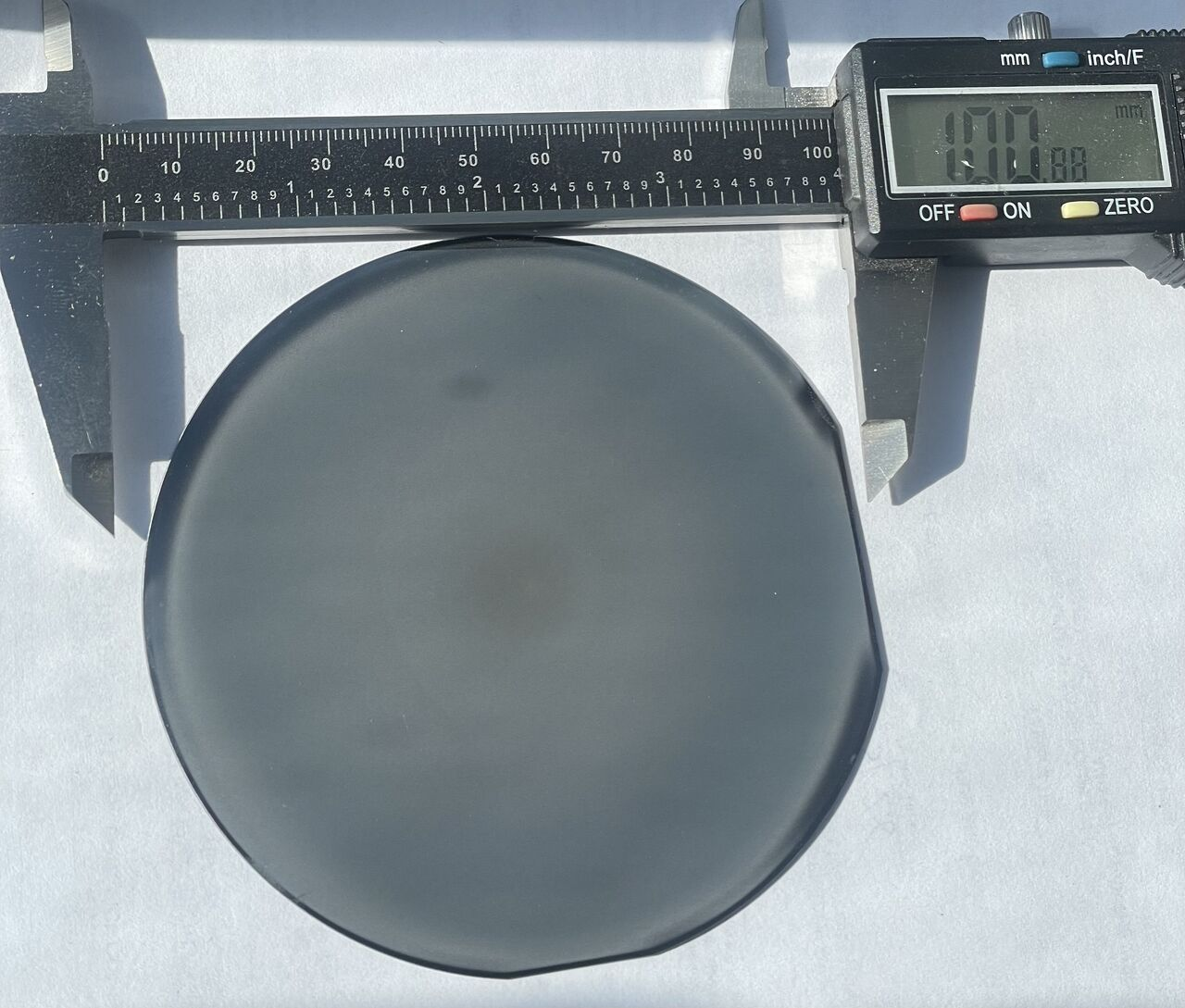
100 mm wafer for BEN and CVD diamond interface development.
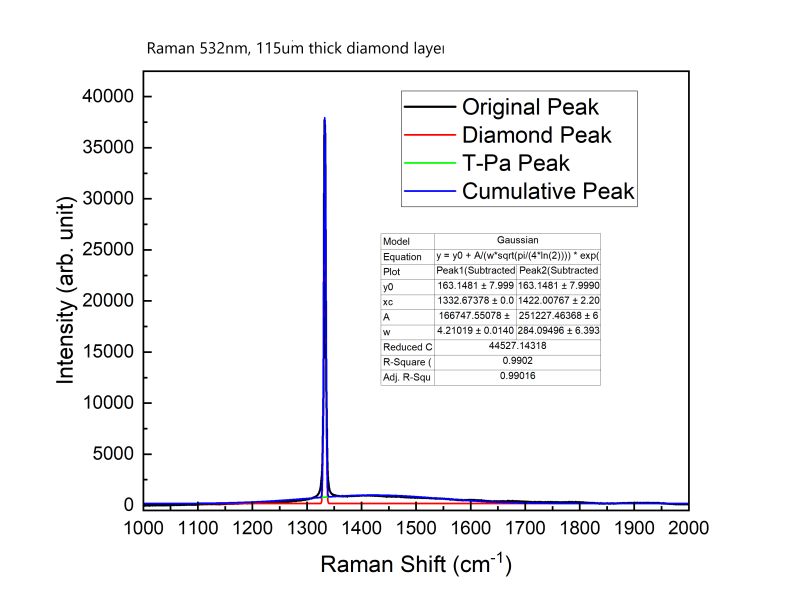
Representative 532 nm Raman spectrum from a 115 micron thick CVD diamond layer on a 100 mm wafer. The diamond peak is centered near 1332 cm-1.
For diamond-on-silicon and related stacks, BEN is intended to improve adhesion, reduce particles and voids, and enable lower thermal boundary resistance compared with mechanically seeded films. In suitable stacks, the development target is substantially higher thermal boundary conductance than conventional seeded interfaces, with independent characterization recommended for customer-specific material systems.
Carat Systems is open to collaborations with device integrators and metrology groups to independently characterize BEN-enabled diamond stacks.